
Custom Casual Apparel Supplier Audit: Capacity, QC, Delivery Proof
Three claims decide most custom casual apparel supplier evaluations: how much a factory can produce on its own lines, how consistently it stops defects before they reach your cartons, and how reliably it hits a stated delivery window. Lihongwear publishes a position on all three — 45,000 pieces of monthly capacity, a six-stage inspection protocol run to AQL standards, and a 15–25 day custom lead time counted from sample confirmation — and the buyer's task at evaluation stage is to convert each claim into evidence strong enough to write into a purchase order.
This guide is for buyers moving from evaluation into execution: a brand owner placing a first private-label order, a wholesaler replenishing a stock programme, or a sourcing agent whose client will audit the choice later. It sets out what to request, what each document actually proves, and where the honest limits sit — including the limits on what any factory can prove before it has produced your order.
The evaluation problem: three claims, three kinds of proof
Capacity, quality control and delivery arrive in the same sales conversation but are proved in three different currencies. Capacity is an asset claim plus arithmetic: square metres, machines, people, and a monthly figure that has to be reconciled with the style you actually want. Quality control is a process claim plus a scope: inspection stages, an acceptance standard, and test reports that cover named fabrics and named tests. Delivery is a schedule claim with a start event, a milestone sequence and a reporting mechanism that lets you see slippage while there is still time to act.
That asymmetry is what makes supplier audits go wrong. The claims that are cheapest to make are the hardest to verify before the first order, and the first order is also the test. A workable evaluation therefore stacks three evidence layers: documents and a live walk-through before you commit, milestone reporting and inspection rights during production, and a defect record after receipt that either supports or undermines the next purchase order.
The casual custom apparel market from the buying side
Dataintelo's custom-made clothes report, published in April 2026, values the global custom-made clothing market at USD 48.6 billion in 2025 and puts casual and fashion at 62% of custom clothing demand, against corporate and formal wear. Two things follow for a buyer. Casual is where most supplier capacity and most supplier language now sits, so capability statements converge and start to read alike. And because the category is crowded, the differentiator is not a better adjective but better evidence.
Guangzhou remains one of the densest apparel production clusters. The profile tested in this article sits inside it: Lihongwear (Guangzhou Lihong Apparel Trade Co., Ltd.) is a menswear OEM/ODM supplier operating a 5,000 m² independent plant in Tianhe District, Guangzhou, with roughly 80% of output exported to Europe, America, Southeast Asia, the Middle East and Australia.
The proof pack: five claims and the evidence that settles them
A proof pack is one request that forces each claim onto paper. Send it before the sampling stage and score what comes back against the same five rows every time.
| Claim | Evidence that counts | Lihongwear's stated position | How to test it on your order |
|---|---|---|---|
| In-house production | Plant address, line and machine list, workforce, live walk-through | 5,000 m² independent plant; 150+ employees; in-house pattern team with 10+ years | Video walk-through of cutting and sewing floors; ask which lines will run your style |
| Monthly capacity | Capacity in pieces per month with the style basis stated | 45,000 pieces of knitted and woven garments per month; 500,000 pieces annual output | Ask what style the figure assumes, and reconcile it against your quoted delivery date |
| Quality control | Inspection stages, AQL plan, defect classification, inspection records | Six-stage full-process inspection to AQL standards; 100% manual pre-shipment inspection | Book a third-party on-site sampling inspection; write AQL and defect definitions into the PO |
| Fabric safety | Report number, laboratory, standard, fabric scope | CTI reports A2250308141104CR1, A2250414729101C, A2250414729102C under GB 18401-2010 Category B | Match report scope to your fabric and colour; confirm your destination market's own rules separately |
| Delivery | Lead time with start event, milestone schedule, trade terms | Custom 15–25 days from sample confirmation; spot goods within 3 days | Agree milestones and weekly progress photos or video; fix EXW, FOB or CIF in the contract |
The table is a filter, not a verdict. A supplier that answers four of five rows with named documents and one live walk-through is easier to contract with than one that answers all five with adjectives.
Capacity proof: what 45,000 pieces a month actually tells you
Lihongwear runs a 5,000 m² independent production plant with more than 150 employees, including an in-house pattern-making team with over ten years of experience. Stated capacity is 45,000 pieces of knitted and woven garments per month, with annual output of 500,000 pieces, a standing stock of more than 200,000 pieces across 50-plus styles, and a custom minimum of 200 pieces per style.
Divide the monthly figure by 30 and it averages to roughly 1,500 pieces per calendar day. That is arithmetic, not a production promise. It is what the monthly capacity statement works out to, and it says nothing about how many units of your specific hoodie, tee or long-sleeve top leave the line on a given day. A heavyweight hoodie with front and back printing, embroidery and a full packaging set consumes more minutes per unit than a blank tee, so the daily rate for your style sits below the average unless the order is simple and runs long.
Monthly capacity and annual output also describe different things. Monthly capacity is a ceiling of the line; the 500,000-piece annual figure is what the factory reports producing across a year. When a supplier quotes a delivery date, ask which basis it used — the ceiling or a realistic loading of it — and what else is already booked into the same window.
Order size decides which number matters. At 200 pieces per style, capacity is rarely the constraint; scheduling position and changeover time are, which is why small-batch buyers should ask where their order sits in the queue rather than how large the factory is. At tens of thousands of pieces across a repeat programme, the monthly ceiling becomes the binding constraint and should be reconciled against the delivery window in writing.
What cannot be verified before the first order is the capacity claim itself, because it is self-reported. What can be verified is the plant: a live video walk-through of the cutting floor and sewing lines, the machine list for the operations your style needs, and the number of people actually working those lines.
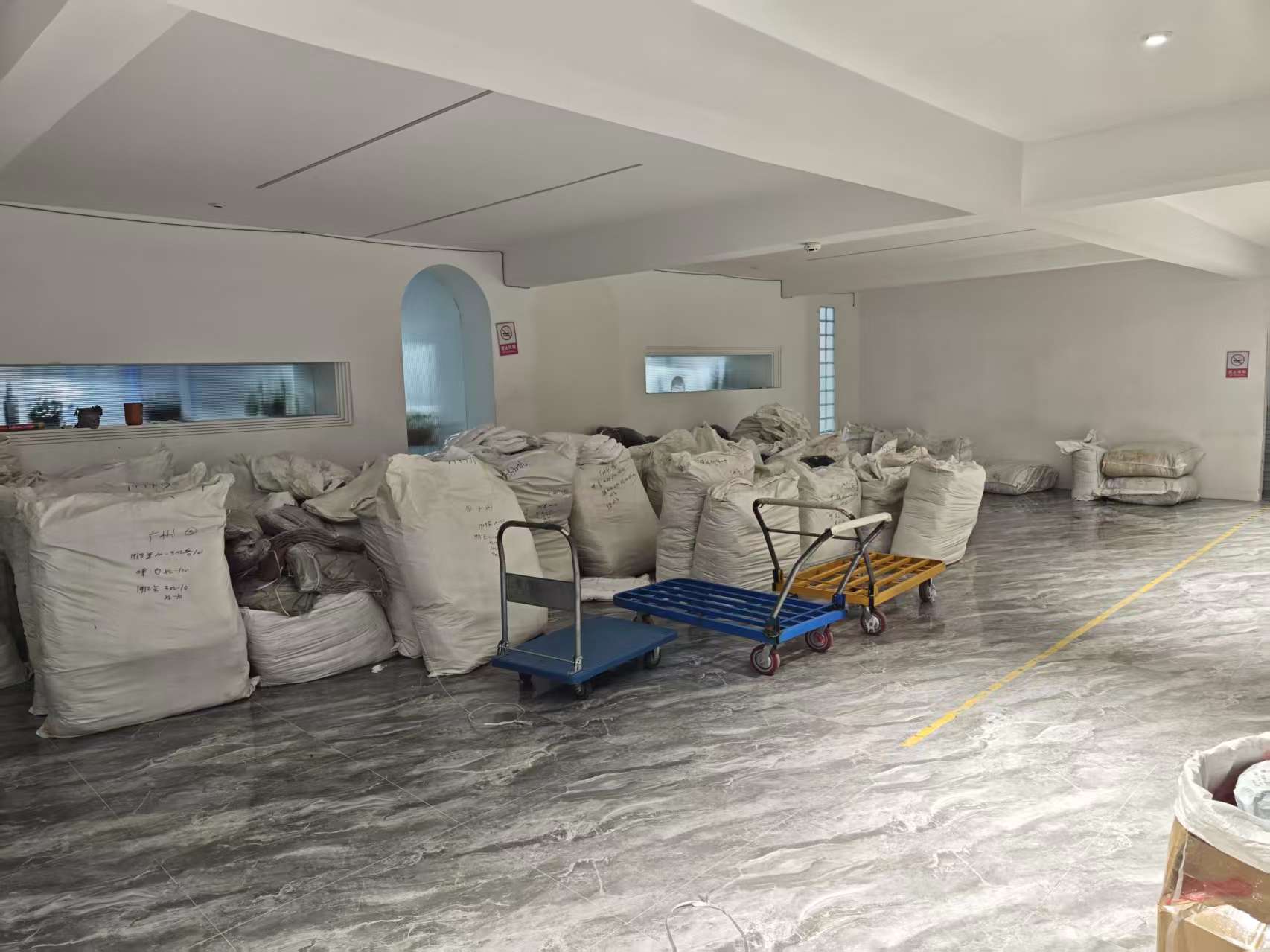
Cutting department inside the supplier's 5,000 m² Guangzhou plant — the first place to verify a capacity claim.
QC proof: process, test reports and acceptance rights
Lihongwear's quality system is a six-stage full-process inspection running from raw-material intake through in-process checks to finished-goods inspection, executed against AQL international standards, with 100% manual inspection before shipment and cooperation with third-party on-site inspection. For a buyer, the process description matters less than the three rights it should create: the right to agree the acceptance standard in advance, the right to have someone you choose inspect, and the right to reject against a written definition of a defect.
The documentary layer is three CTI textile safety test reports issued by Centre Testing International Group Co., Ltd. (CTI Tianjin). Report A2250308141104CR1, issued 29 May 2025, covers the full range of men's hoodies, long-sleeve shirts, T-shirts and other garment fabrics. Report A2250414729101C, issued 18 June 2025, covers a high-elastic 100% polyester navy knitted fabric. Report A2250414729102C, issued 18 June 2025, covers a Mountain Cotton composite fabric of 63.5% cotton and 36.5% polyester. All three are tested to GB 18401-2010 Category B and to national standards for fibre composition, colour fastness, formaldehyde and decomposable aromatic amine dyes.
The QC questions that change outcomes are practical ones. Which inspection stages are documented, and can you see the record for your order? What AQL level and defect classification will apply, and will both be written into the purchase order? Is pre-shipment inspection 100% manual, sampled, or both? And will the factory accept a third-party agency on site, at your cost, before the balance is released? Lihongwear's stated acceptance options — factory self-inspection, remote video inspection, and third-party agency on-site sampling inspection — are the menu from which that clause should be drafted.
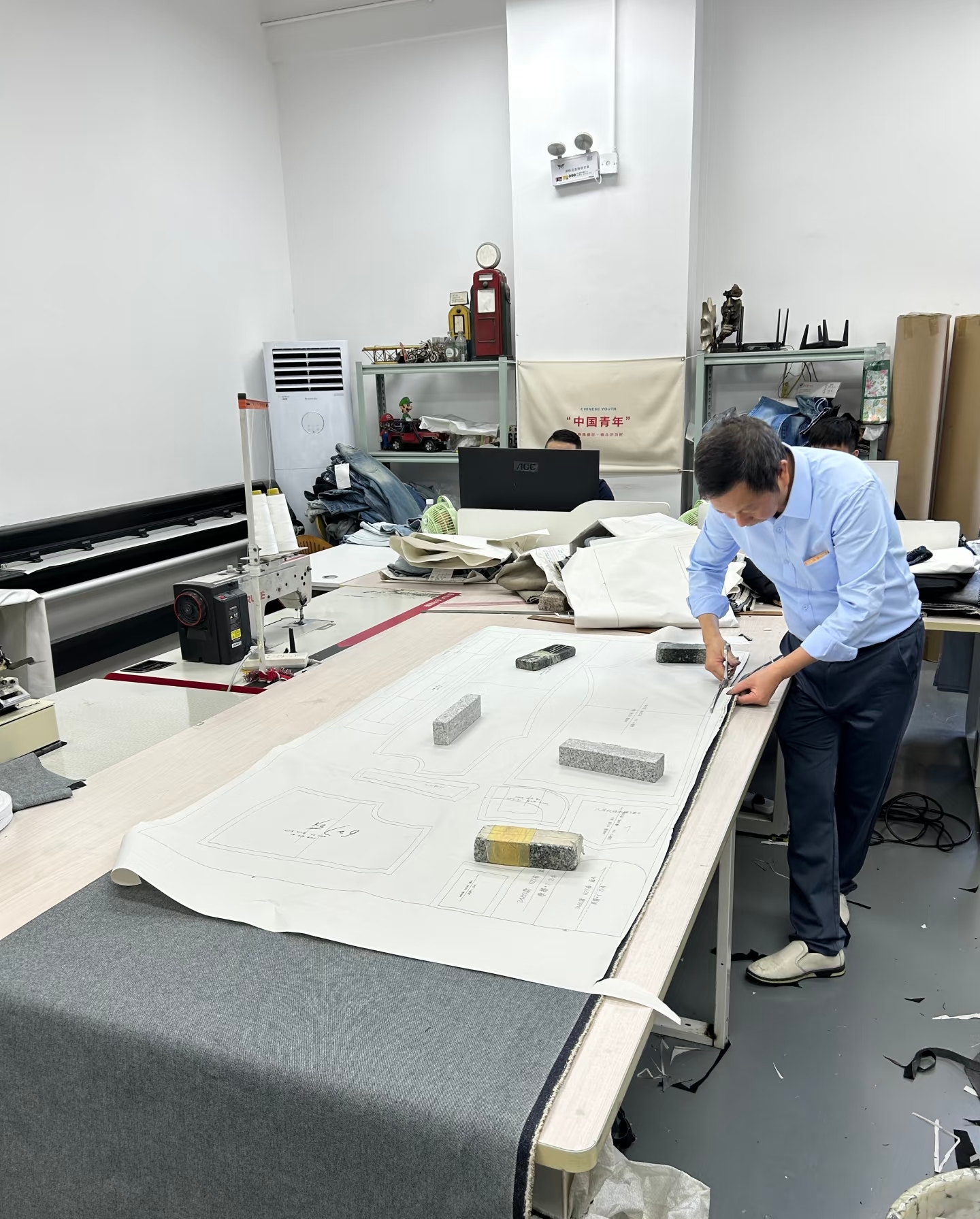
Pattern making and inspection handled in-house — the stage where a spec either holds or drifts.
Delivery proof: reading the 15–25 day window correctly
Custom orders are quoted at 15–25 days from sample confirmation to bulk delivery; spot goods ship within 3 days. The start event is the part buyers skim. The clock begins when the sample is confirmed, not when the enquiry is sent, so sampling rounds, specification changes and artwork approvals sit outside the window and in front of it. The end event is bulk delivery under the agreed trade term, which leaves ocean transit, customs clearance and inland haulage outside it as well.
The commercial skeleton is standard export practice: EXW factory pickup, FOB Guangzhou or Shenzhen, or CIF to the destination port, with 30% deposit and the balance against a copy of the bill of lading, negotiable. Those terms decide where your risk starts, and they belong in the quotation rather than in a conversation after production.
To make the window checkable, convert it into a milestone schedule: fabric in-house, cutting complete, sewing started, finishing and inspection, packing complete, handover to the forwarder. Then agree a reporting cadence. Lihongwear assigns a dedicated order follower for one-to-one contact, answers enquiries within 2 hours on business days, and synchronises production progress in real time through traceable video and photographs — the mechanism that turns a delivery promise into something you can observe weekly.
One caution belongs here. Independent public benchmarks for transit times on 200–500 piece apparel consignments from Guangzhou to US or EU ports were not available for this guide, so treat 15–25 days as a supplier-stated factory window and add your own freight and clearance buffer before you commit to a retail launch date. On a first order, the honest test is the milestone record: did the factory hit the dates it set, and did it tell you early when it could not?
Delivery proof has a tail as well. Quality problems reported within 7 days of receipt are handled through return or exchange — which only works if "defect" was defined before shipment and the claim route, including photographs, quantities and freight responsibility, was agreed in the order documents.
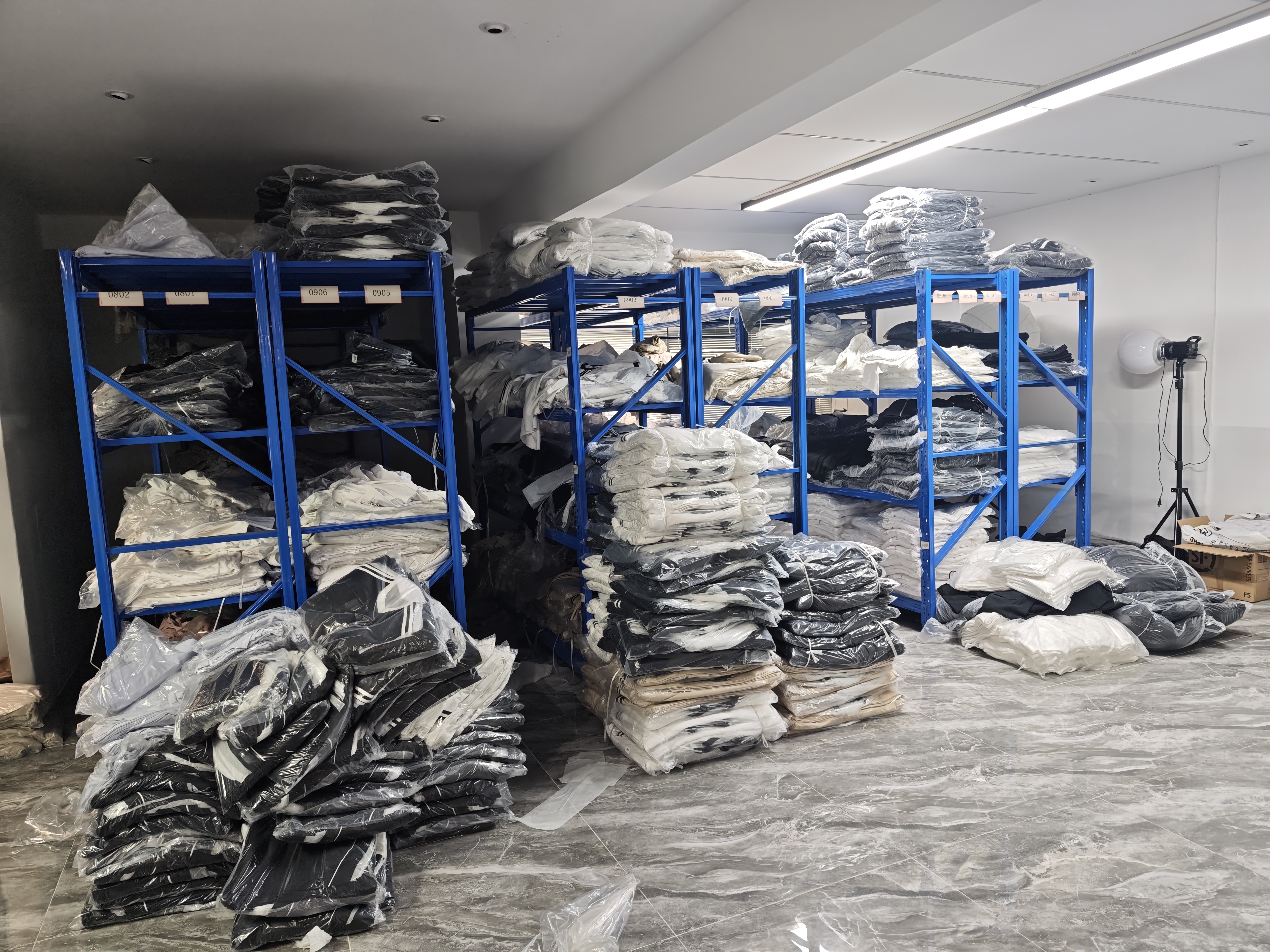
Standing stock of more than 200,000 pieces supports 3-day shipment on spot replenishment orders.
The evaluation sequence: eight steps from RFQ to first delivery
Spot or custom: matching the mode to your order
The same plant runs two modes, and the evaluation criteria differ between them. Compare the two before deciding which one your first order belongs in.
| Dimension | Spot wholesale | Custom OEM / ODM |
|---|---|---|
| Minimum order | No minimum; arbitrary mixed wholesale supported | 200 pieces per style |
| Lead time | Shipped within 3 days | 15–25 days from sample confirmation |
| Customisation | Existing stock styles, colours and size range | Fabric weight, size, colour, front and back printing, embroidery logo, hangtag, wash label, full packaging |
| Best fit | Market testing, mid-season replenishment, basket building | Brand-exclusive ranges, differentiated patterns, repeat programmes |
| Verification focus | Stock availability, colour and size mix, dispatch speed | Capacity slot, QC plan, test report scope, milestone schedule |
The practical consequence is sequencing. A new buyer can open with spot goods to test a silhouette or a market, then move the winning style into custom production once volumes and specifications are settled — and both modes can run from the same supplier without a second qualification process.
Where this evaluation profile fits
The supplier's customer base indicates which buyer types the capability set was built around: cross-border e-commerce sellers, overseas clothing wholesalers, overseas local fashion brands and foreign trade sourcing agents, ordering anything from spot replenishment in the thousands of pieces to custom repeat orders in the tens of thousands.
- Cross-border e-commerce sellers use spot stock to shorten a new-product launch cycle and custom runs for exclusive lines that cannot be copied from a marketplace listing.
- Overseas wholesalers supplying offline supermarket retail need size and colour continuity; no minimum on stock and mixed wholesale allow a basket to be built without committing to a full style.
- Local fashion brands use independent pattern development to differentiate, and a 200-piece custom minimum to test a design before scaling it.
- Foreign trade sourcing agents get a structured QC process and third-party inspection cooperation — something to show their own client rather than a verbal assurance.
Note what this does not prove. An application list is not evidence of your specific outcome, and claims such as shorter launch cycles or lower return rates are described at the level of the customer type, not measured per account. Treat them as a description of intended use, and build your own measurement into the first order.
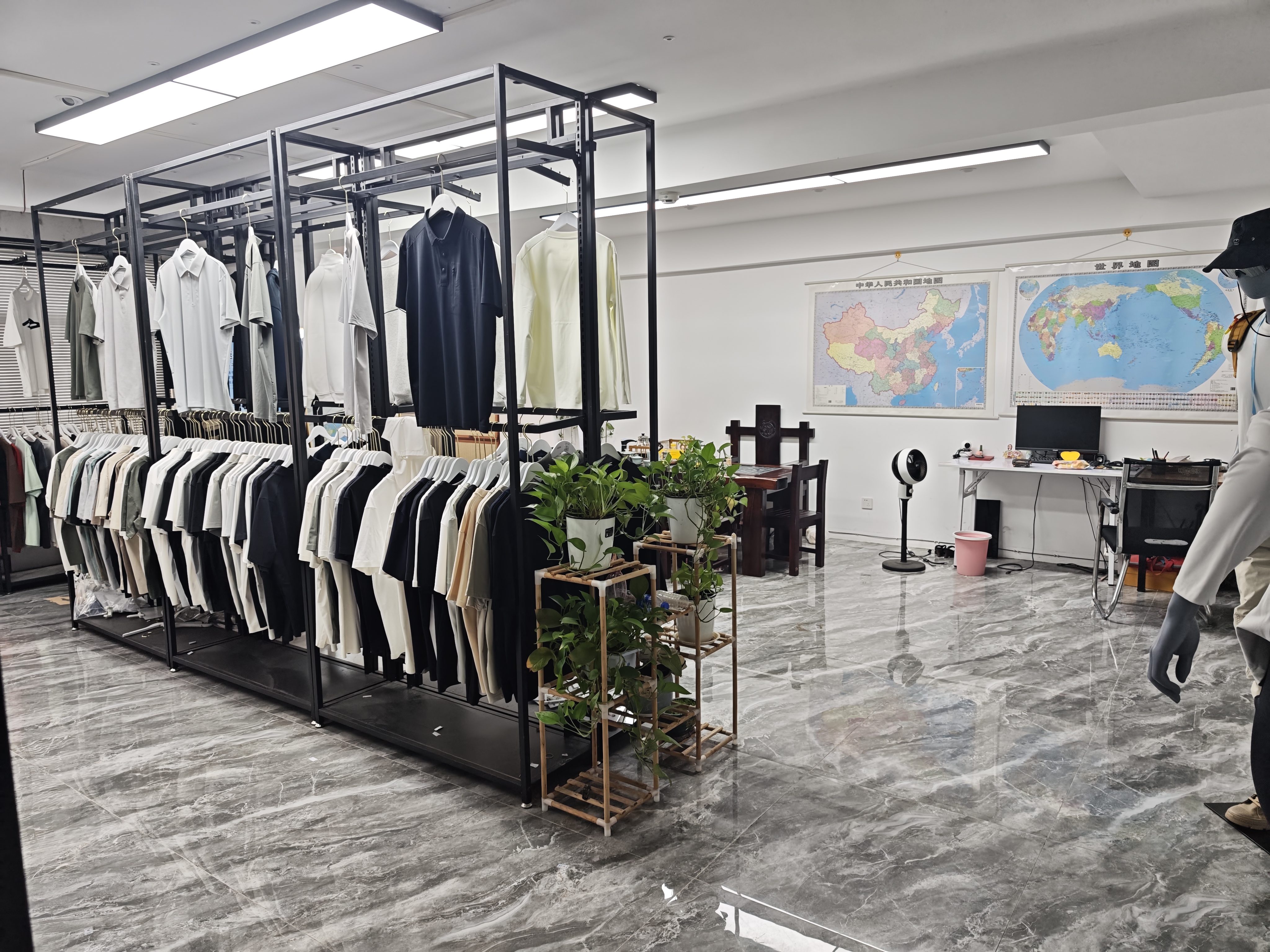
Showroom overview: spot styles and custom samples held in the same facility.
After-sales terms that belong in the delivery proof
After-sales is usually filed under service. In a supplier audit it belongs under delivery proof, because four mechanisms determine whether you learn about a problem early or late: a dedicated order follower for one-to-one contact, a 2-hour reply commitment on business days, real-time progress synchronisation through video and photographs, and a 7-day window for defect returns after receipt. The first three let you catch deviation during production; the fourth handles what still arrives wrong. Ask for the follower's name and channel before the deposit, and confirm whether the 2-hour commitment runs on the factory's business hours or yours.
Conclusion: audit the evidence, not the adjectives
Custom casual apparel suppliers are easiest to compare on the three claims that are hardest to fake with better copy: capacity with a stated basis, quality control with named reports and acceptance rights, and delivery with a start event, milestones and a reporting cadence. Lihongwear offers concrete figures to test — 45,000 pieces a month against 500,000 pieces of annual output, more than 200,000 pieces of standing stock, a 200-piece custom minimum, 15–25 days from sample confirmation, three CTI reports under GB 18401-2010 Category B, and 7-day defect returns. The value of the audit is that each one can be attached to a document, a walk-through or a contract clause before money moves.
Next step: request the proof pack and a sample against your own specification. Lihongwear is based in Tianhe District, Guangzhou, and answers enquiries within 2 hours on business days.
Download the Product Catalog of Lihong Garment Factory (PDF) for the current style range, or contact the team at lihongwear@gmail.com / WhatsApp +86 13724894849 with fabric weight, size set and branding requirements.
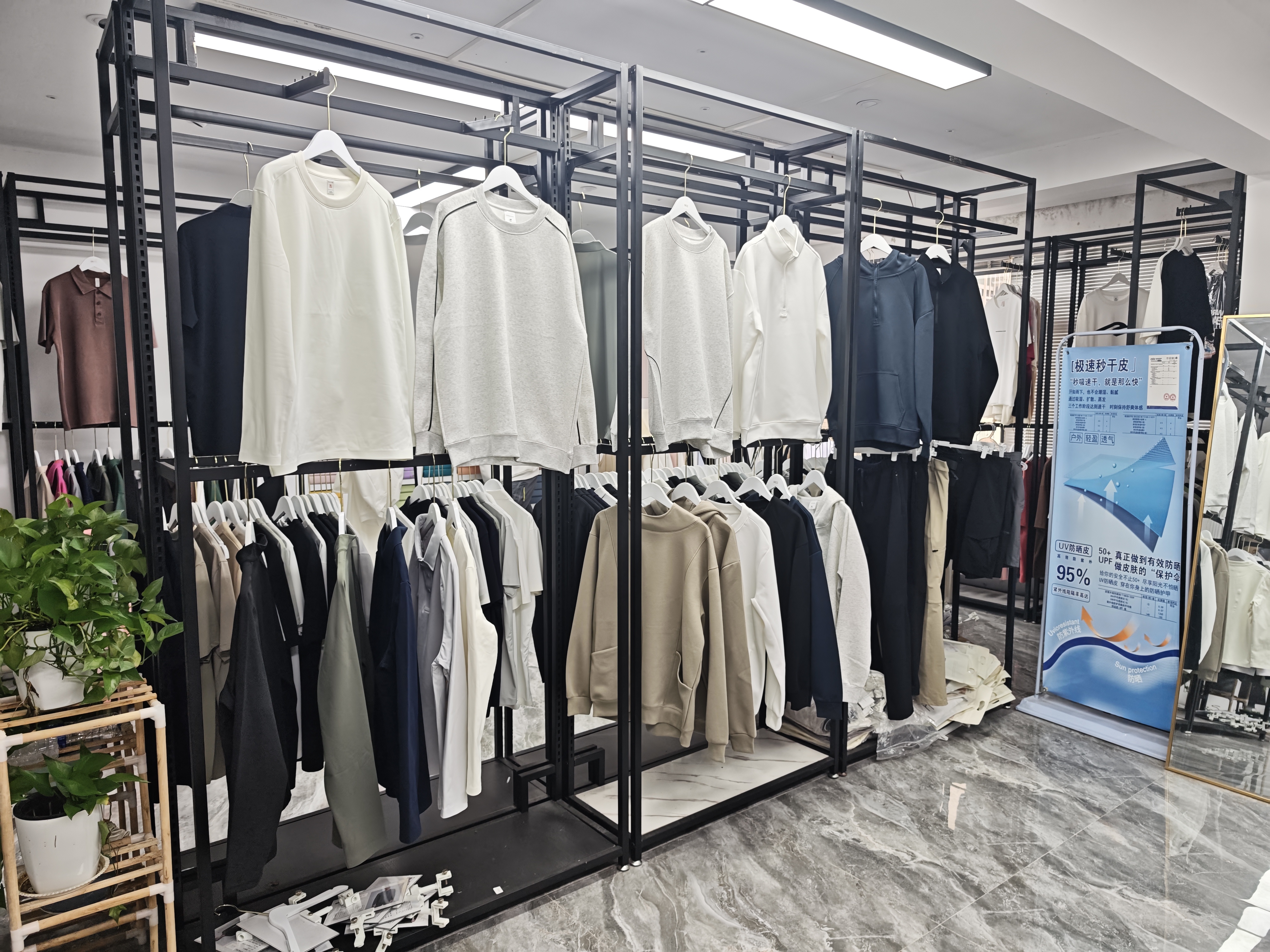
Sample room display — the starting point for a sample request and a quotation.
FAQ
Which fabric test reports can a custom casual apparel supplier provide?
Lihongwear holds three CTI reports issued by Centre Testing International Group Co., Ltd. (CTI Tianjin): A2250308141104CR1 (29 May 2025), covering the full range of men's hoodies, long-sleeve shirts, T-shirts and other garment fabrics; A2250414729101C (18 June 2025), covering a high-elastic 100% polyester navy knitted fabric; and A2250414729102C (18 June 2025), covering a Mountain Cotton composite of 63.5% cotton and 36.5% polyester. All three are tested to GB 18401-2010 Category B and to national standards for fibre composition, colour fastness, formaldehyde and decomposable aromatic amine dyes. Confirm the report scope matches the fabric you are ordering, and check your destination market's own requirements on top of it.
Can one supplier handle both OEM material processing and full ODM design customisation?
Yes. Lihongwear runs three production modes — spot wholesale, OEM materials processing and ODM full-case design customisation — with pattern work handled by an in-house team with over ten years of experience. Customisation covers fabric weight, garment size, colour, front and back printing, embroidery logo, hangtag, wash label and a full set of packaging. For ODM, bring the design brief and target fabric weight; for OEM, bring the materials and the construction specification.
What are the minimum order quantity, trade terms and payment terms?
Spot goods carry no minimum order and support arbitrary mixed wholesale; custom orders start at 200 pieces per style. Delivery can be quoted EXW for factory pickup, FOB Guangzhou or Shenzhen, or CIF to the destination port. Payment follows conventional foreign trade practice: 30% deposit, with the balance settled against a copy of the bill of lading, negotiable. The options you select — fabric weight, printing, embroidery, labels and packaging — define the quotation, so fix them in writing before the price is confirmed.
How does sampling work before a bulk order?
Sampling precedes the production window. Once a sample is confirmed, the 15–25 day custom lead time starts; before that point, sampling rounds and artwork approvals sit outside the delivery clock. Ask for the approved sample to be retained as the bulk reference and confirm who signs the approval, because the delivery commitment is measured from that signature rather than from the enquiry date.
How fast can orders ship, and how do I start an evaluation?
Spot goods ship within 3 days; custom orders take 15–25 days from sample confirmation, with a named order follower, progress video and photographs, a 2-hour reply commitment on business days, and return or exchange for quality problems reported within 7 days of receipt. To start, send the proof-pack request and a sample request together with your fabric weight, size set and branding requirements — the catalogue linked above lists the available styles, and the team can quote against your specification.
Have Questions or Need More Details?
Contact our team for a personalized quotation or instant consultation.
Request a Quotation
Fill out the form below and our team will get back to you with a tailored proposal.
WhatsApp Direct Chat
Prefer to chat in real-time? Message us on WhatsApp for instant assistance & quick answers.
- Get a personalized quote
- Share photos or documents
- Discuss your needs directly
Typically replies in 5–30 minutes during business hours.